


Statement by Mr. Temuri Pipia, Counsellor of the Permanent Mission of Georgia to the UN at the UN Security Council High Level Open Debate on Promoting International Peace and Security through Multilateralism and the Peaceful Settlement of Disputes
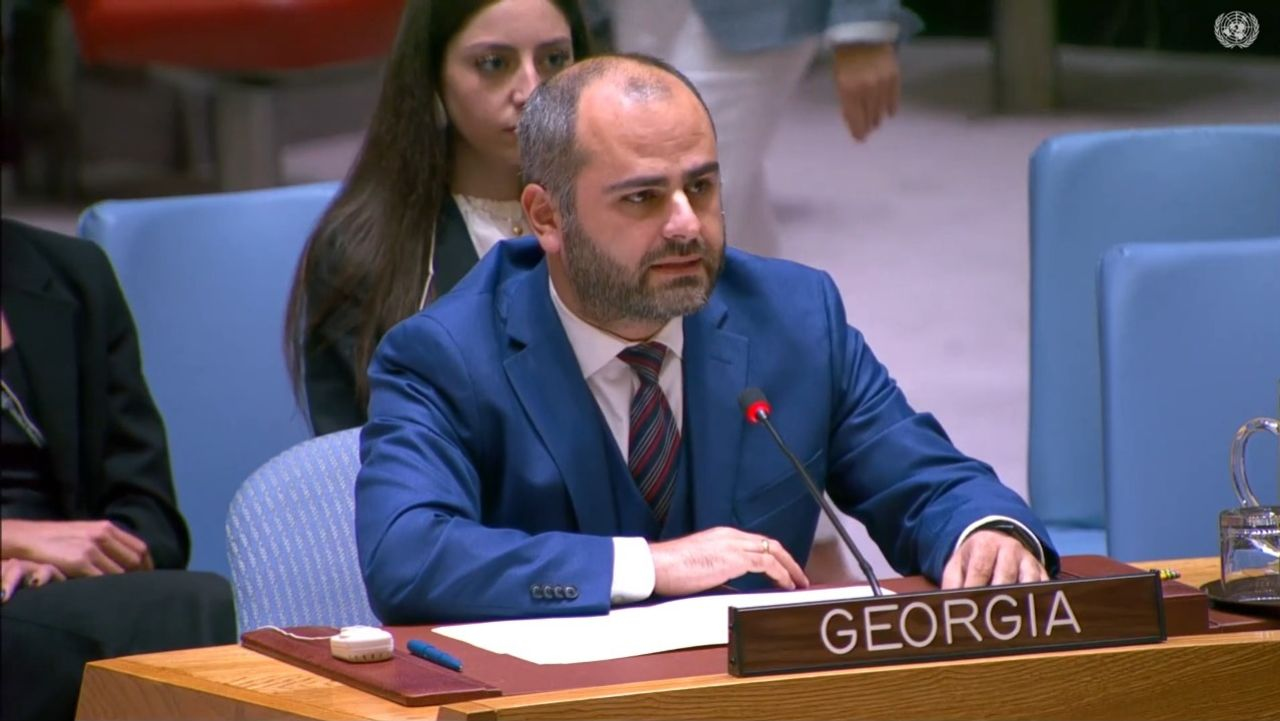
In his remarks, the Counsellor of the Permanent Mission of Georgia to the UN, Mr. Temuri Pipia underscored Georgia's unwavering commitment to multilateralism and a global rules-based international system, with the United Nations at its core, as essential instrument for maintaining international peace and security.
He highlighted the current challenging period for multilateralism, noting that nearly eight decades since its founding, the UN's core principles are frequently violated, leading to widespread conflicts. He further emphasized the exacerbating impact of grave threats such as hybrid warfare, pandemic diseases, cyber-related threats, the rapid spread of disinformation, and unmitigated climate change on global stability.
Temur Pipia indicated that, regrettably, Georgia itself is a victim of these violations, as Russia's illegal occupation of Georgia’s two regions – Abkhazia and Tskhinvali region – persists. Temur Pipia stated that this occupation is a blatant violation of fundamental principles of international law, the UN Charter, and other international commitments of the Russian Federation, including the EU-mediated August 12, 2008 Ceasefire Agreement.
The statement touched upon severe impact that ongoing illegal occupation have on the local population and areas adjacent to the occupation line, while both regions remain heavily militarized with full-fledged Russian military bases. Georgian delegate expressed deep concern over Russia's persistent efforts towards the de-facto annexation of these Georgian territories, gradually illegally integrating them into its military, political, economic, social, and legal systems. He also noted that international human rights mechanisms are still denied access to the occupied regions.
It was underlined that Georgia firmly believes that robust multilateralism and strict adherence to a rules-based international order are indispensable for eliminating these threats, ensuring international peace and security, upholding human rights, and achieving sustainable development. However, the multilateralism can only be effective when all members of the international community consistently abide by common rules and principles.
In this context was emphasized that Georgia supports comprehensive UN system reform, particularly within the Security Council, as reflected in the recently adopted "Pact for the Future." It was underlined that Georgia advocates for equitable representation and enlargement of the UNSC, reform of the use of the veto, and improved working methods and decision-making principles. These reforms, coupled with increased accountability before the General Assembly, are crucial for enhancing the Council's legitimacy, authority, and credibility.
Temur Pipia concluded by reiterating that the collective promise for peace, security, human rights, and sustainable development hinges entirely on a steadfast commitment to the UN Charter and international law. He also highlighted the vital role of coordination between the United Nations and regional organizations in conflict prevention, post-conflict recovery, reconstruction, and development, given their unique capacity to address regional and sub-regional challenges.